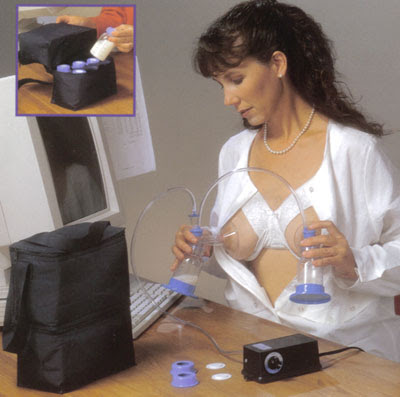
Showing posts with label working mothers. Show all posts

Thursday, September 3, 2015

It's Time for ALL Working Moms to Have Legal Protection for Pumping

Salaried health care workers deserve the same rights as hourly workers!

by Glenni Lorick, IBCLC

If you work as an hourly employee in a store, restaurant or business with more than 50 employees, your employer is legally required to provide you a place to express or pump your breastmilk (a bathroom isn't acceptable) and whatever break time you need to do so. This fact sheet explains the details of the law as it is currently written. However, if you are a teacher, a physician or any other kind of salaried employee, the law doesn't provide you any protection at all.
Some employers like HEMSI  work
 hard to accomodate mamas.
 

Last year I wrote a blog about this topic and mentioned the Supporting Working Mothers Act of 2013 which was sponsored by Senator Jeff Merkley from Oregon. Unfortunately our lawmakers didn't care enough about mothers and babies to act on this legislation, and they allowed it the bill to die.

Nevertheless, the United States Breastfeeding Committe (USBC) is mounting a campaign to once again find a sponsor for the Supporting Working Mothers Act so that it can be introduced in the upcoming session of congress. You may not be a very politically active person, but please take just a moment to get involved in this very important issue. It isn't a Democrat or a Republican issue. No, it is a MOTHER'S RIGHTS issue. It is a BABY'S RIGHTS issue. Every mother and baby should have the right to sustain their breastfeeding relationship after mother returns to work. Sadly many do not have that option because employers fail to understand the many incredible benefits for everyone involved including the employer!

This school counselor has
been able to pump as needed. 

Benefits for Mom and Baby

The numerous benefits for moms and babies have been well documented. Babies who receive their mothers' milk receive antibodies to anything that mom is exposed to. They also have reduced incidence of all the following:

Upper respiratory infections
Ear infections
Gastrointestinal infections
Juvenile diabetes
Childhood leukemia

Mothers who breastfeed receive tremendous health benefits as well.

Increased chance of healthy loss of extra pregnancy weight
Reduced risk of premenopausal breast cancer
Reduced risk of postpartum depression
Reduced risk of osteoporosis and ovarian cancer later in life

Benefits for Employers

Every working mother should
have this right!
Many employers do not realize that when they empower their workforce to breastfeed according to the AAP recommendation they will also benefit the bottom line of their company in a variety of ways:
  • Increased retention of employees following maternity leave
  • Reduced incidence of absenteeism due to working mothers having to care for sick babies
  • Greater job satisfaction reported leading to long-term employee retention
  • Reduced costs for employer-funded insurance plans because the medical costs during the first year of life are drastically reduced. 

The first step you can take is to click on this link which will take you to the USBC campaign. Scroll down to the bottom where you can enter your zip code to send an email to the representative for your congressional district.

Next repost this information to everyone you know

Wednesday, December 31, 2014

Pumping Time for Working Moms

by Glenni Lorick, IBCLC
From AccordingtoTrish.com

Recently an employee at a large company asked me about pumping. The supervisor was only allowing nursing mothers on a 12 hour shift to pump at lunch and during two 15 minute breaks. She wondered if that was okay.

According to the law, it is definitely NOT okay. In fact, it is downright illegal! The Fair Labor Standards Act mandates that hourly employees be given as much time as necessary to pump their milk as well as a place to pump that is NOT a bathroom.

How Often Can I Pump?

The law does not set any specific time limits on how often you can pump. But nursing mothers often need to pump at least every 3 hours to maintain a good supply. So it is not unreasonable to expect a mother working a 12 hour shift to need to pump about 4 times. Depending on how her body responds to the pump, she may need to pump for 15-20 minutes, then she needs to have time to get set up and to clean up afterwards. Obviously a pre-mandated 15 minute break is simply not adequate for most moms.

What If I Don't Work for a Big Company?

While it is true that the companies who employ a total of fewer than 50 people MAY be exempt, those companies are NOT automatically exempt. It is up to the company to prove a genuine hardship would be sustained if they had to meet the requirements of the law.
From The Primal Parent

What If I Am Not Paid Hourly?

At this point the law does not specifically address salaried employees, only hourly employees. However, measures have been introduced to change that. The Supporting Working Mothers Bill did not pass last year, but breastfeeding advocates will continue to push legislators to extend pumping benefits to all working mothers.

What if My Employer Refuses to Comply?

While it is true that Alabama is a fire-at-will state, the law is very specific about mothers who receive recrimination or any harassment for demanding their pumping rights. If you think you have been discriminated against because you expected your employer to follow the law, you can file a complaint here.

Monday, March 24, 2014

Nursing Mama & CEO - Making it Work

Sabrina Pinions, CEO of Palo Alto Software with Baby # 3
by Glenni Lorick, IBCLC

I have had the privilege of helping many moms combine work and breastfeeding over the years. We are lucky to have federal law on our side now. Working mothers who receive an hourly wage and are employed by a company with at least 50 employees benefit from the Department of Labor mandate that ensures adequate pumping time along with a place to pump (that isn't a bathroom). I love helping working mothers figure it all out. We put together a pumping plan that they can use when they return to work 6-12 weeks after baby comes.

However what happens when mom IS the CEO?  Some people might say something like, "That's great! She can take as long as she wants!" As the owner of a small business (I don't use the title CEO because we're not that big yet), I realize just how impractical that thinking is! As impractical as it is for the CEO of a larger company, it is even MORE difficult for a small business owner.

Gina (name changed to protect privacy) had begun her business shortly before her third child was born on a Friday afternoon. Saturday morning while she was still in the hospital, she received a call from a potential big-dollar client that went to her answering machine. When she got home Sunday, she heard the call and returned it Monday morning, asking if they could meet in a week or so. However, the client wanted to meet immediately. So Gina took her personal assistant with her to watch the baby and headed to the client's office at 4 days postpartum! She got the account and didn't miss a beat nursing her baby.

Marissa Mayer and Baby Macallister
The challenges a CEO faces are going to be different from those of an employed mom. The whole business is really dependent upon the CEO. So she needs to plan a little differently than a regularly employed mom would do. However, because she IS the CEO, she gets to make the rules! That's where it gets fun!! She can create any kind of climate she wants to in the workplace. Her example of breastfeeding her baby may be just what it takes to encourage her employees to pump and nurse.

It is unfortunate that some people think you can't mix being an executive with breastfeeding! Obviously, that isn't the case at all! Take, for example, Sabrina Pinions of Palo Alto Software. When she had her third child in 2010, she wasn't able to take a maternity leave. But she was able to bring her baby with her to work! Marissa Mayer, CEO of Yahoo, has actually built a nursery next to her office so she can bring her baby to work. While she has received criticism for insisting that Yahoo employees no longer work from home, as a savvy CEO, she recognizes that having access to her baby so she can nurse is important for her own well-being which translates into the well-being of the company.

Making it Work For YOU

So what can you do when YOU are the CEO to ensure a successful breastfeeding experience? I have a few tips - take what works for your situation!

  1. Plan ahead. Before your baby is born create a breastfeeding plan. Realize that in the first few weeks your baby will need to nurse every 2 - 3 hours from beginning of feed to beginning of feed, so create your schedule and plan your meetings accordingly.
  2. Take advantage of The Bottle Window. Don't give your baby a bottle until breastfeeding is well-established, but be sure you introduce it by the time baby is month old!
  3. Involve your personal assistant as much as possible in the day-to-day operation of the business. If you don't have a personal assistant, identify someone who can help shoulder the burden during the first few weeks so that you can really focus on those things that ONLY you can do.
  4. Enlist your spouse's support as Chief Bouncer to allow your time at home to be restful. Your body does need to recover from birth, and you do need rest, even if, like Gina, you are meeting a client at 4 days postpartum! People may want to come by to see you and the baby, but it might be more important for you to focus on baby and on yourself.
  5. Be sure that you are eating 2400 calories/day, and focus on really nutritious foods. Some great foods for nursing moms include avocados, almonds, oatmeal, Ovaltine and lactation cookies
  6. Incorporate baby into your life. Be creative! Wear your baby at work. Practice nursing discreetly in a sling. A newborn basically sleeps and eats, so if baby gets accustomed to being worn early on, it will make it much easier for you.
  7. Don't worry about your house. If you haven't hired a housekeeper yet, now is the time to do so. Keeping your house clean should be the least of your worries! You might find that in the early days you need to increase the frequency of her visits if she isn't with you on a full time basis. Add laundry to her duties if you haven't already!

Your Unique Position

You are truly in a unique, enviable position. You have the opportunity to run a business, to nurture a new life, and to create a different kind of work environment. As you settle into life with your new baby, you will further appreciate the sacrifices the mothers who work in your company are making when they return from maternity leave. Your own experience may very well lead you to create an increasingly family-friendly environment in your company. You may begin to think outside of the box about how you can support nursing mothers in your company. The end result is that everybody in your company wins!


Wednesday, November 6, 2013

Planning Your Maternity Leave

From Today's Parent
You've made it through the first trimester of your pregnancy and feel halfway human at work again. But now it's time to think about your maternity leave! It may still be several months away, but experts say that planning in advance is the smartest thing you can do. Recently we asked some of our ANM moms what they wish they had known ahead of time about maternity leave.

Prepare Financially

Maybe you have been putting away part of every paycheck to prepare. Or perhaps you are just
Google images
living from paycheck to paycheck. The reality is that your finances WILL change when you add a new member to your family. Kimberly Rotter examines this issue pretty thoroughly in this post on the Credit Card Insider Blog.

One of our moms suggested that you save all your vacation and personal time so you can add weeks to the 6/8 weeks your employer gives you.

Prepare Professionally

If your job is important to you, you need to make sure that you have all your bases covered before returning to work. Some of our moms found that their employer considered their maternity leave permanent. They said that it was hard to get back into the swing of things at work. If you are in a position of responsibility, it will be important for you to make sure that you have properly trained your replacement and that everyone on your team will respect and respond properly to that person. 

From sheknows.com
One mom suggested that you "get all the info on paperwork from HR well in advance. Work with your boss to make sure you don't leave things in a mess (have someone who knows what you were working on so they can cover.) Start tying up loose ends as your due date gets closer. Keep your boss informed on how long you will be out." She recommended reminding your boss, "I will be out in about X weeks. Is there anything you need before I go...I'll be back 12 weeks afterward."  

If you are due for a performance evaluation while you will be on leave, be sure to communicate with your boss about that. One of our moms noted that her employer conducted her performance review while she was on leave.

If you are a teacher, you will need to make sure that your students will be covering the material they need to cover and getting the instruction they need. Careful planning will help significantly. However, one of our moms said, "Relax! Life will go on without you in the classroom for a few weeks."

Prepare Emotionally

Several of our moms mentioned feeling lonely and isolated when they were on maternity leave. One mom suggested that you should find things to do or line up visits with people. However, another mom offered the suggestion that you may actually need to rest more and limit visitors! One excellent suggestion was to "Let other people help when they offer...even if it's just doing your dishes." Other great advice included, "Be sure to start pumping early." (Usually we recommend beginning to pump daily after the first feed each morning once your supply is established.) Be sure to introduce a bottle when baby is about a month old.

Some moms found that they were more than ready to return to work when their leave ended. One
From Forbes.com
mom said, "It is okay to want to go back to work. Some people aren't meant to stay home." Another mom added, "13 weeks was enough for me. I was ready to have adult time again!" Don't feel guilty if you are eager to get back to work. One mom recalled, "I used to feel bad for loving my work and not wanting to stay hom." Guilt takes way too much energy! Don't do that to yourself!

On the other hand, some moms really struggle with the idea of returning to work. One mom remembers, "I took 16 weeks of maternity leave thinking it would be enough. I wish someone had told me not to bother with maternity leave and just go ahead and follow my instinct and quit right then. Haha! I took that leave, went back to work, then immediately put in my notice to quit after almost 9 years...and never looked back!"  Another mom concurred, "Now I couldn't imagine going back to work just to leave my baby with someone else!"

You may decide that you really would like to stay home, but just don't know how to swing it. This blog has some pretty creative ideas for ways that you can boost your family's finances if you do decide to stay home after baby comes. Of course I am passionate about helping moms stay home by helping them save money and make money. I would be happy to talk with you about it.

Remember, 9 months will go by faster than you can imagine. Regardless of what you plan to do, make sure you do have a plan!!


Wednesday, September 11, 2013

All Working Moms Deserve Breastfeeding Support

From Healthfulmama.com
Do you work for an hourly wage? If you work for a company with more than 50 employees, they are required by law to provide you a place that is not a restroom as well as adequate break time to pump milk for your baby.  However, if you happen to be a salaried employee in that very same company, you just might be out of luck. The law requires absolutely NOTHING in the way of breastfeeding support from your employer. This law provides terrific support for the millions of hourly employees across this county. Nevertheless, professionals who receive a salary have absolutely no legal support.

In my practice I frequently work with teachers who are returning to work. Many local principals are very understanding and do try to find a way to help their teachers continue pumping. But not all. Sometimes a mother has to choose between breastfeeding and returning to her job simply because there is no accommodation. Teachers are on a very tight schedule and may not have two 20 minute segments during the day for pumping. With ever-tightening school budgets, unless the force of law is behind it, some school administrators will never see this as a priority. Pharmacists, lawyers, physicians, engineers and upper management personnel all find themselves in this same situation.

That is why the Supporting Working Moms Act of 2013 has been introduced in both the House and
Contact Senator Lamar Alexander
from Tennessee with your support.
the Senate this year. This act extends those benefits to salaried employees, as well. On May 9 it was introduced in the House and referred to the House Education and the Workforce committee. Then it was introduced in the Senate on May 13 and referred to the Health, Education, Labor and Pensions committee. Unfortunately, many bills end up dying in committee due to a wide variety of factors. However, YOU have the chance to make a difference!

You can do several things. First, take a look at the representatives on the House committee. If you live in Alabama, you have one representative on that committee. Take a minute to write her and let her know how important this issue is. Then look at the Senate committee. If you live in Tennessee, you actually have a ranking member on this committee!

Congresswoman Martha Roby
is on the House committee
Next you can write directly to your elected senators and representative telling them why this bill is so good for the country. It honestly is a bill that should cross political party lines because whether you are a Democrat or a Republican, you recognize the importance of improving the health of the nation's children via a simple vote that requires absolutely no financial commitment by anyone and actually ends up saving employers money! If you are unsure about how to contact your officials, click here. You will enter your zip code, and receive contact information for both senators and your representative.

If the bill fails this year, then urge your senators and representatives to co-sponsor the bill next year. Unfortunately, the chances of its passing this year look slim. However, if there is a loud public outcry in favor of it, even the nearly impossible can happen! Will you take 5 minutes right now to send a few emails??

Tuesday, April 30, 2013

Freestyle Breast Pump Review

by Guest Blogger, Elizabeth S., Huntsville, AL

The Medela Freestyle

BACKGROUND:  I am a working mother with a 6 month old.  I pump 3-4 times (30 minutes-1 hr sessions) during the workday and breastfeed 3-5 times a night and all the time on the weekends.  I do not have an over-abundant milk supply, but when breastfeeding exclusively my supply is fine.  I rented a Symphony breast pump for 2 months after my son was born, then switched to the Freestyle a week before I went back to work at 2 months postpartum.   I pumped at work using the Freestyle exclusively for 4 months.  I purchased the Freestyle from a big-box retailer after consulting only online reviews.  At the time I purchased the pump, I didn’t know any lactation consultants or working mothers who pumped, and purely from a research standpoint, the Freestyle sounded like the workhorse I was looking for.  Luckily, between the time I purchased the Freestyle, and the time I needed to use it, I discovered A Nurturing Moment and their team of lactation consultants, so when I had problems, I knew where to start looking for answers. 

RECOMMENDATION: I DO NOT recommend purchasing Medela’s Freestyle Breast Pump. 

“It’s like pumping with a jackhammer.”

PROS:
The membranes, connectors, and backplates are easy to clean (much easier than the Pump-In-Style or
The Freestyle is intended to simplify pumping.
Symphony) and do not extend into the collection bottles, allowing collection of more milk.  The pump is highly portable, small, lightweight, rechargeable (up to 6 hrs of pumping on one charge of the battery, but you have to plug it in whenever you’re not using it), can function plugged into the wall outlet if desired, hands-free (I used the Simple Wishes pumping bra instead of the hands-free adapter kit), has a decent way to secure the pump to your waist,  never got moisture in the tubing, can do single or double pumping, and I loved the included timer and memory button that would remember and repeat your last pumping session.  I really wish I could recommend this pump, because the pros were awesome.

CONS:
With each suck, serious vibration that is part of normal Freestyle pump operation is transferred directly to your breasts.  Over time, this caused me recurring breast tissue irritation, swelling, pain, and damage to my skin.  The pump did not fully empty my breasts at the highest setting I could tolerate (Level 4), which caused me to have issues with engorgement and severe difficulty pumping out enough milk to feed my son.  The only way I could handle the vibration somewhat was to slather myself with Lanolin before every pumping session, but all the symptoms above still occurred.  Medela doesn’t make the SoftFit breastshields that come with this pump in any size besides Medium, does not sell any as spare parts, and I could not use the PersonalFit breastshields (Medela’s regular breastshields) with this pump because they made the vibration issue ten times worse.  The pump is also extremely pricey and twice as loud (at least) as the Pump-In-Style or the Symphony.  I would place the Freestyle on the arm of my chair or on the table and feel the vibration throughout my body.  I changed from the Freestyle to the Symphony, and in the same session where I usually got 5 ounces with the Freestyle, I collected 7 ounces using the Symphony (time of day, pumping duration, and all other variables being equal – I ran this comparison the very next day, so the Symphony hadn’t had time to increase my milk production any). 

PURCHASING TIPS – ITEMS TO CONSIDER:  When you purchase a breast pump, give some thought to the customer service.  I didn’t, and now I’m out ~$400 for the pump, $120 for the connectors, membranes, and backplates, had 4 months of pain and stress, and almost lost my milk twice.  (I just hope there’s no long term damage.)  If you’re a working mother, an inadequate pump can sabotage your breastfeeding relationship with your child.  And the danger can be subtle – it took me a month to figure out what was going on after I realized there was a problem somewhere.  Yes, prices are higher at A Nurturing Moment than at the big-box or online retailers, but there is absolutely no substitute for Glenni’s customer service!  If you want Glenni and her team of lactation consultants to be around to help you with your breast pump and breastfeeding accessory purchases and concerns and problems in the future, then buy things from her today.  Or support your local breastfeeding accessory store and lactation consultants if you don’t live in the Huntsville, AL area.  And no, Glenni didn’t (and won’t) pay me to say that.  It’s just common sense.  Consider the following:
  • Will the sales personnel at the retailer where you plan to purchase your breast pump know anything about pumping, about combination breastfeeding and pumping, or about the problems you might encounter? 
  • Can your retailer show you how to set up and use your pump?  Yes, I know pumps come with instruction manuals, but I had no idea if my pump was working right after I put it together – it made strange noises, and was awkward, and I had no idea if the breastshields were a good fit.  I needed some hands-on help.  You might too. 
  • Does your retailer have lactation consultants on staff you can consult with when you have issues? 
  • Will your retailer try and sell you a pump that will meet your personal needs after some discussion with you, or will they just sell you anything? 
  • Can you swing by your retailer for help when something’s not working, and physically show them what’s wrong?  Some problems can only be demonstrated. 
  • Can your retailer’s lactation consultants provide an informed opinion on whether your problems are caused by your pump, your baby’s suck pattern or latch, your diet, an infection, etc., and provide educated guidance on how to fix them? 
Surely it’s worth the extra few bucks to keep A Nurturing Moment or your local breastfeeding accessory store and lactation consultants in business. 


Friday, March 22, 2013

The Bottle Window

I got an interesting call from a mom today. She was wondering if we had any written information about how to introduce a bottle to her breastfed baby. Although I often address this issue, I realized I had never written about it. So I promised her I would put my suggestions into writing tonight!

Why Introduce a Bottle?

Honestly, not every mother even needs to worry about introducing a bottle. If you are going to be home with your baby and really don't want to be separated until baby is several months old, then I wouldn't even worry about reading the rest of this post! By the time your baby is about 6 months old, you can begin introducing a cup with expressed breastmilk, so if you're cool with hanging out with baby for those first six months, then you don't need to concern yourself with "the bottle window."

However, if you know that you will be going back to work, or if you want your baby to be able to accept an occasional bottle of breastmilk, then it is really important to understand when and how to introduce a bottle. Sometimes Mom just wants to be able to have an occasional date with Dad or night out with the girls. And many dads do indeed look forward to the time when they can participate in feeding.


When Should I Introduce the Bottle?

There is a small window of time for introducing a bottle to your baby. You need to make certain that beastfeeding is well established. Baby should be latching on well, and your milk supply should be sufficient for baby's needs. However, if you wait too long, your baby may completely refuse to take a bottle. If you really need baby to take a bottle, waiting too long can present tremendous challenges.

The ideal time to introduce a bottle is between four weeks of age and one month.

The ideal time to introduce a bottle is between four weeks of age and one month. That's a pretty small window. But in my experience with hundreds of babies and moms, it seems to be the perfect time. I have almost never had a baby who is one month old or younger refuse a bottle. Likewise, if breastfeeding is going well by four weeks, introducing a bottle is highly unlikely to cause any kind of problem with baby's suck.

How Should I Handle Pumping?

The ideal time to pump is right after the first feed of the morning. You have the most abundant milk supply at that point. I generally encourage mothers to wait until baby is a couple of weeks old and their supply is somewhat stabilized to begin pumping. The easiest way to pump is with a double pump, and with the changes from the Affordable Health Care Act, most policies cover a breast pump. 

The easiest way to store your milk is in Milk Trays. You don't have to keep buying bags or filling your freezer with bottles. The milk tray will freeze your milk in one ounce cubes which can be stored in ziplock bags after they are frozen. Be sure to write the dates on the bag (you will probably have several days or a week's worth of milk per bag). 

Once you have introduced the bottle, you will also want to pump during the time that the bottle is being given so that your breasts will continue to receive the same amount of stimulation. Skipping a feed without pumping could also lead to engorgement, plugged ducts and mastitis - NOT fun!!

How Do I Introduce the Bottle?

First of all, YOU aren't going to be the one to give baby a bottle! Let Dad , Grandma, your bestie or even an older responsible sibling be the one to give the bottle. Remember that while someone else is feeding baby, you are pumping!

It is important that baby receive a bottle at least every 2-3 days. I can't tell you how many moms call me distraught because their baby who took a bottle or two really well at one month won't take any kind of bottle at 2 months. When I investigate a little bit, I discover that baby hasn't had any bottles for about 3 weeks. That's a problem. Babies are creatures of habit, and the bottle is a habit you have to continue to cultivate if you want baby to accept it.

What Kind of Bottle Should I Use?

Generally when mothers introduce the first bottle during "The Bottle Window" just about any bottle will work. However, you really want to find a bottle that requires baby to suck using the same basic motion that he uses at the breast. You also want to find a slow-flow nipple. 

Just about any bottle will work

Several good options that have worked well for our moms include the First Years BreastFlow bottle, the Mimijumi bottle, The Tommy Tippee bottle and both the Medela Calma and the Medela standard slow-flow bottle. Each has pros and cons. I would just buy one bottle of a particular brand at first to see how your baby does with it. Don't make a real investment into a particular brand until you know that they are going to work.

No Judging!

I feel like I need to close a discussion of the use of bottles with a final caveat. Whether you decide to introduce a bottle or not, you need to be comfortable with your decision. Every situation is unique, so there is absolutely NO ROOM for any mom to judge another mom based on how she decides to handle this issue. The most important thing we can do as moms is get in the habit of affirming each other every chance we get!

Monday, August 27, 2012

Action Step 14: Employer Support

This is the final week of the US Breastfeeding Committee's 20 Actions in 20 Days Campaign. Today's action step is one that is a high priority for us at A Nurturing Moment - such a high priority, in fact, that we have an entire program designed to help employers in this area!

Today's step comes from pages 50-51 of the Surgeon General's Call to Action to Support  Breastfeeding.


Action 14. Ensure that employers establish and maintain  comprehensive, high-quality lactation support programs for their employees. 


Photo courtesy of Stockfree images
In the United States, a majority of mothers have returned to the workplace by the time their infants are six months old. Continuation of breastfeeding after returning to work is facilitated if the employer offers a lactation support program. The evidence demonstrates that supportive policies and programs at the workplace enable women to continue providing human milk for their infants for signfiicant periods after they return to work. High-quality lactation programs go beyond just providing time and space for breast milk expression, but also provide employees with breastfeeding education, access to lactation consultation, and equipment such as highgrade, electric breast pumps. Currently, only a quarter of U.S. employers provide breastfeeding employees with a place to express breast milk at the workplace.

Implementation Strategies 

Develop resources to help employers comply with federal law that requires employers to provide the time and a place for nursing mothers to express breast milk. As part of the Affordable Care Act enacted in 2010, the Fair Labor Standards Act was amended to require employers to provide reasonable break time and a private place for nursing mothers to express milk while at work. Programs are needed to educate employers about the new law, supply examples of how it can be implemented in a variety of work settings, and provide assistance to businesses that find compliance difficult.

Design and disseminate materials to educate employers about the beneits of providing 
more comprehensive, high-quality support for breastfeeding employees. The Health Resources and Services Administration resource kit, The Business Case for Breastfeeding: Steps for Creating a Breastfeeding Friendly Worksite, is one model of how to promote employer support for breastfeeding employees. Developing Web sites, videos, conference exhibits, and peer-to­-peer marketing strategies could all be useful for expanding the use of lactation programs and implementing effective programs across a variety of work settings. New materials that focus on the unique concerns of non-office work environments and workplaces with few employees should be developed.

Develop and share innovative solutions to the obstacles to breastfeeding that women face when returning to work in non-office settings. While there are numerous examples of creating lactation rooms in office buildings and large stores, many work environments are more challenging for breastfeeding women returning to work. For example, farm workers may find it difficult to access a private place shielded from public view. Service workers who are on the road may not have a regular workplace where they can express milk. Challenges also exist in allowing break time for breast milk expression in businesses where there are few employees to cover during breaks. Many employers have already worked with workplace lactation consultants to develop innovative solutions, such as special trailers, makeshift temporary spaces, or “floater” employees, to enable nursing mothers to take breaks.


Promote comprehensive, high-quality lactation support programs as part of a basic 
employee beneits package. There are cost savings from better retention of experienced workers, higher employee morale, greater loyalty and productivity of employees, reduction in absenteeism and sick leave taken by parents of young children, and lower costs for health care and health insurance. While the percentage of employers having lactation support programs has increased over the past decade, many women still find it difficult to combine breastfeeding with work.

Getting Involved

If you've been around A Nurturing Moment very long, you probably know how committed we are to supporting working mothers. We often consult with moms who are returning to work to help them figure out how they will manage pumping and working. We've worked with mothers in a wide variety of industries and love to help them make continued breastfeeding a success.

Last year we began a special program designed specifically to help employers support their nursing employees - just like the last point of the Surgeon General's call suggests! ANM Workplace Solutions is available to any company in the Tennessee Valley who wants to offer exemplary support. We provide an on-site support group, hospital grade breast pumps, and in-home lactation consultation for employees! If your company isn't offering you this kind of support, then have your HR people get in touch with us! We'd love to help!

Wednesday, August 1, 2012

World Breastfeeding Week: Celebrating 20 Years of Breastfeeding Promotion

It has been 20 years since the World Alliance for Breastfeeding Action (WABA) launched the first World Breastfeeding Week campaign. The theme that first year was "Baby Friendly Hospital Initiative." So much has happened in these last 20 years! Let's look at how far we've come.

  • The Innocenti Declaration from 1990 has continued to be a guiding force in breastfeeding promotion.
  • In 1992 the Healthy Mothers, Healthy Babies Coalition received a grant to move forward with the Baby Friendly Hospital Initiative (BFHI) in the US. Wellstart International in San Diego, CA, developed the assessment tools.
  • In 1997 the Healthy Children Project, Inc. accepted responsibility for the initiative and formed Baby-Friendly USA to implement the BFHI in the US.
  • In 2002, The World Health Organization (WHO) and UNICEF reaffirmed the Innocenti targets and added additional targets in the Global Strategy for Infant and Young Child Feeding.
  • In December of 2011, Regional Medical Center in Anniston became the first Alabama facility to receive the Baby Friendly designation.
  • As of May, 2012, 143 hospitals and birth centers in the United States have received this designation.
However, we still have a very long way to go! One of the goals of this year's World Breastfeeding Week is to call attention to the state of policy and programs related to the feeding of infants and young children.

The New York Initiative
Just yesterday there was a lengthy discussion on the WHNT facebook page about the Latch-On NY initiative which encouraging participating hospitals not to give free formula to women and to only distribute formula when medically necessary. A mother who chooses to formula feed will first learn about the benefits of breastfeeding her baby, at least while she's in the hospital. No mother will be denied formula, nor will any baby ever go hungry. The program is voluntary and simply helps hospitals take steps toward becoming Baby Friendly.  What the critics don't understand is that many hospitals are already doing this - there's been no fanfare or political upheaval about it; rather, they have simply implemented evidence-based medicine in their facilities.

Help for Working Moms
An argument that I have seen repeatedly in this discussion is the hardship that returning to work while breastfeeding imposes on women. The US Department of Health and Human Services office on Women's Health put together a promotion called The Business Case for Breastfeeding. It is very true that many women do indeed struggle. That is why it is so important for employers to recognize the important role they play in supporting their breastfeeding employees. Programs like ANM Workplace Solutions help employers provide the level of support necessary, and actually have a positive Return on Investment!

Truth in Advertising for Formula Companies
This week let's celebrate how far we've come, but let's recognize how far we still have to go! Let's help women and doctors alike understand that breastfeeding isn't just a matter of maternal choice. It is a decision that can affect their baby's health. It's time for our government to sign onto the International Code for the Marketing of Breastmilk Substitutes and stop allowing formula companies to mislead the public. 

No Guilt! Lots of Support!
Should mothers who don't breastfeed be made to feel guilty? No, I don't think this is about guilt. But every mother should have the opportunity to know just why breastmilk is so important for her baby. Furthermore, every mother should have the support necessary to breastfeed successfully.

Thursday, July 26, 2012

Does "Breast is Best" Create a Hardship?

Photo of PumpEase courtesy of  http://www.snugabell.com/
I just came across an interesting article posted in the New York Times in which Jane Brody attempts to use a recent serial  interview study from Scotland to prove a point. She says the American Academy of Pediatrics goal that women exclusively breastfeed for about 6 months is unrealistic and imposes undue hardship on mothers. She relies somewhat on her personal experience 43 years ago when she had her twin sons early by C-section and pumped her milk as they were being fed formula in the hospital. Obviously that wasn't a terribly auspicious beginning for Ms. Brody, and she didn't have the advantage of a supportive lactation consultant since the profession didn't exist 43 years ago. Her OB was quite supportive, but her pediatrician was not, and I must say that I really admire her determination to breastfeed her sons despite some incredible obstacles and without a strong support network.

However, the thing that concerns me the most is the perception of a continued lack of support for nursing mothers in the workplace. Federal law mandates not only that breastfeeding mothers be given break time whenever they need to pump, but it also says that employers with 50+ employees are required to provide a place for pumping that is NOT a bathroom. Many employers have made huge strides in accommodating nursing mothers; nevertheless, some companies may still be unaware of the legal requirement to support these employees. It is vitally important that the women who work in these companies make their HR people aware of their responsibility.

A Nurturing Moment actually has a special program in place specifically designed to help employers offer the best support available to mothers. The return on investment is incredible. Cigna conducted a 2 year study of breastfeeding employees and found that their workplace lactation program produced the following results:

  • $240 million annual savings in health care expenses
  • 62% fewer prescriptions
  • 77% reduction in absenteeism
Mutual of Omaha had the following results with their lactation program:

  • 83% employee retention after maternity leave (national average is 59%)
  • Healthcare claims per breastfed newborn averaged $1269 compared to $3415 for formula-fed infants.
That leads us into a discussion of my second major concern with Ms. Brody's article. She asserts that there is no research to back up the claims of the medical community that breastfed babies are healthier. It looks to me like Mutual of Omaha has done some research that backs that up!(Mutual of Omaha. (2001). Prenatal and lactation education reduces newborn health care costs.Omaha, NE: Mutual of Omaha.) Furthermore, the AAP statement is backed up by significant research. In fact, it contains 151 citations to support it's recommendations. The Academy of Breastfeeding Medicine has also responded to the Times article with a statement calling for enhanced support for all nursing mothers. 


This isn't about Mommy Wars or "Milk Wars." It's about a public health initiative. The worst thing that anybody can do is use guilt in an attempt to motivate a woman to nurse. Guilt is a lousy motivational tool. It is even more awful for anyone, breastfeeding advocate or not, to make a mother feel guilty about her feeding choice once that choice has been made. Life is just too short for guilt! 


So what do we need to do? First of all, we need to make sure that all mothers have access to good prenatal education about breastfeeding. They need to know that it may be challenging. They also need to know where to turn if they do have any problems.  Next, we need to realize that, as one mother so aptly put it, "It takes a village to breastfeed a baby." (thanks, Elizabeth!) That village includes health care providers, community support groups, family, friends, and breastfeeding professionals.  Finally, we all need to strive to make the workplace more supportive for nursing moms. Are you in management? Do you own a business? Do you know someone who does? Find out what they're doing to help their nursing mothers. Ask questions before you get pregnant. If your children are older, then see what you can do to smooth the way for younger women. If we all work together, we can help more moms succeed and avoid a lot of unnecessary guilt.

Monday, January 30, 2012

ANM Workplace Solutions

Photo by Criminalatt from
FreeDigitalPhotos.net
Since our inception, A Nurturing Moment has helped working mothers navigate the frustrations of returning to work, pumping and continuing to breastfeed. We love it when moms who work outside the home tell us their breastfeeding success stories. Nothing thrills us more than to hear that one of our mamas has provided her baby breastmilk for a year or even longer.

Over the last few years, we've had moms ask us to provide information to their employers, and we've been happy to do that. However, we are ready to take it a step further now! ANM Workplace Solutions is an exciting new service that we are providing to companies in the Tennessee Valley!

We want to help area companies to be recognized by the Alabama Breastfeeding Commission as Breastfeeding Friendly Workplaces. We offer a variety of services tailored for each individual company we serve. We will help a company design a lactation room and provide them a hospital-grade pump to use in the room if they want one. However, we will also provide 24/7 phone consultation to their employees as well as to their spouses. Other options include in-home breastfeeding support, monthly support groups on-site for nursing mothers, and breastfeeding classes. Employees will also receive a 10% discount on everything they purchase at A Nurturing Moment.

The best part of all is that solid research shows that companies which offer a lactation support program benefit in many ways. They have a higher employee retention rate, enjoy greater employee satisfaction, and experience threefold savings in their health care costs. If you think your company would appreciate results like that, have your HR folks give us a call at 256-489-2590 to get more information. If you would prefer that we contact your business ourselves, leave a comment or give us a call!