 |
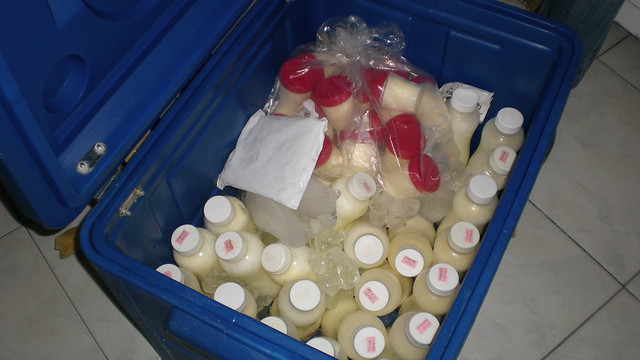
| Photo from Modern Milk Sharing |
I've got great news for you! You can take it home with you - even if you're flying! The Transportation Security Administration has actually created a page specifically to address the needs of traveling parents. Basically, parents are allowed to carry whatever breastmilk, baby food or infant formula that their infant will need. Furthermore, mothers traveling without their babies are also allowed to carry breast milk.
Of course, every mother knows that keeping breast milk cold is vitally important. The TSA has addressed that as well. I called today and spoke with a very knowledgeable and helpful agent who actually sent me additional information.
Of course, every mother knows that keeping breast milk cold is vitally important. The TSA has addressed that as well. I called today and spoke with a very knowledgeable and helpful agent who actually sent me additional information.
Breast Milk
- Breast milk must be separated from other property and declared to a
Transportation Security Officer (TSO) prior to entering the checkpoint. Parents are allowed to bring as much breast milk as they will need for the trip. Mothers who have pumped and frozen their milk while traveling may bring that frozen milk with them.
Photo from Daphne ph - If you don't want your breast milk to go through the X-ray screening, you must request an alternative screening before placing it on the belt.
- When traveling with an infant or toddler, passengers are also allowed to bring into the screening checkpoint more than 3.4 ounces of pre-mixed baby formula (in a liquid, or frozen state); milk products; juice; gel or liquid-filled teethers; bottled water; and canned, jarred, processed baby food and essential non-prescription liquid medications. You must declare these items to a TSO prior to entering the checkpoint.
- While passengers may be requested to open a container, they will never be asked to test or taste any of these items. If a container cannot be opened, the containers may be allowed into the sterile area only after it and the passenger undergoes additional screening, which may include a patdown.
- All frozen items are permitted as long as they are solid and in a “frozen state” when presented for screening. Cooling liquids or gels used to keep medical or infant child exemptions cold are not bound by 3-1-1 requirements and may be presented at the screening checkpoint in a frozen or partially-frozen state. It is important to remember, however, that any item must be properly screened before being allowed into the secure area of the airport.
Breast Pump
- Individuals traveling with or without a child may bring a breast pump through the screening checkpoint. However, all child-related devices are subject to screening by the Transportation Security Administration (TSA).
- You will be asked to place the breast pump in a plastic bin provided at the screening checkpoint and onto the x-ray conveyor belt before walking through the walk-through metal detector. If it does not fit through the x-ray machine, Transportation Security Officers will visually and physically screen the item.
- You may place it in a clear plastic bag prior to x-ray screening if you are concerned about contamination, but you must provide your own plastic bag.
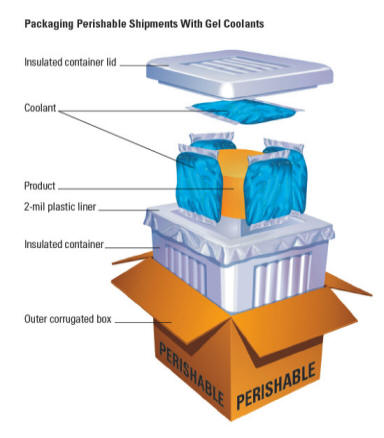
Cooling Elements
Current Transportation Security Administration (TSA) regulations permit regular
ice, frozen gel packs, and dry ice in checked baggage and carry-on bags.
Checked Baggage: Regular ice and frozen gel packs in checked baggage are not
restricted by TSA. When regular ice is transported, TSA recommends a cooler.
For dry ice:
 |
| Courtesy of Eats on Feets |
- TSA requires that its packaging permit the release of carbon dioxide gas.
- The Federal Aviation Administration (FAA) limits each piece of checked baggage to five pounds of dry ice.
- The FAA requires that each package of dry ice be marked “DRY ICE” or “CARBON DIOXIDE SOLID."
- The FAA requires that each package of dry ice be marked with the net weight of the dry ice or an indication that the amount of dry ice is five pounds or less.
- TSA requires that its packaging permit the release of carbon dioxide gas.
- The FAA limits each piece of carry-on baggage to 4.4 pounds of dry ice.
- The FAA requires that each package of dry ice be marked “DRY ICE” or “CARBON DIOXIDE SOLID."
- The FAA requires that each package of dry ice be marked with the net weight of the dry ice or an indication that the amount of dry ice is 4.4 pounds or less.
