Showing posts with label frozen breast milk. Show all posts

Saturday, August 1, 2015

Mom Transports 200 oz. of Breast Milk from Hawaii to Alabama

by Krystal Ness, Guest blogger

Hi, I'm Krystal!  I have two children (4 yr old girl and 1 yr old boy).  I was unable to breastfeed my first due to a low supply, so I was adamant about making it work with my second baby.  From the beginning things were phenomenal!  He latched on right away and for the majority of our nursing relationship things went smoothly.  I work outside of the home, so pumping was a daily activity for me (nurse when I was home and pump at work).

When my littlest was 10 months old I took a business trip for 2 full weeks.  I was so nervous about all things breastfeeding that I was literally nauseated while sitting at the gate waiting to board.  Would my baby take the frozen milk I pumped? Would we have enough for the full 2 weeks?  Would I be able to find the time and room to pump while away from my baby?  Would my supply go down because he's not latching?  How do I get my milk back home after I pump it?  This was no easy trip either.  I was going to Hawaii -- thousands of miles away from my little boy.

The trip out there was long, but after I got settled into my condo I got into a rhythm pumping before work, at work, and after work each day.  I felt like that was all I was doing.  The place I was working did not have a room that I could use so I either pumped in the bathroom (making sure I was sanitary) or I pumped in my rental car.  After nearly 2 weeks I had about 200 oz. of frozen milk.  During my trip I called FedEx and UPS to find out how to ship my milk.  I was so disappointed to find out that the quickest they could get it to Alabama was 48 hrs.  I thought there was no way to get my milk home.  I had spent countless hours during this trip pumping, remembering why I spent the time and effort to pump, and my hopes that he would be nourished with it were dashed.  I was in tears.  I couldn't fathom throwing away that much milk.

The only option I had was to check my milk with my luggage.  I remember being so incredibly nervous walking up to the check-in counter.  "Do you have any explosives, firearms, or flammable material in this cooler?" No.  Phew!  "If you don't mind me asking what is in this cooler?" Frozen Breastmilk.  My inner self winced as I wondered whether she would have a problem with this, but her response was as if it was completely normal that I was traveling with my own milk from Hawaii to Alabama.  I was home free.  The only thing I worried about after that point was whether or not my luggage would get lost.  Standing at the Huntsville Airport waiting for the cooler I heard the ding of the luggage belt.  Within 30 seconds I saw my box crest over the luggage conveyor!  It made it!  When I got home, the milk was still completely frozen.  Pumped with love in Hawaii.  :-)

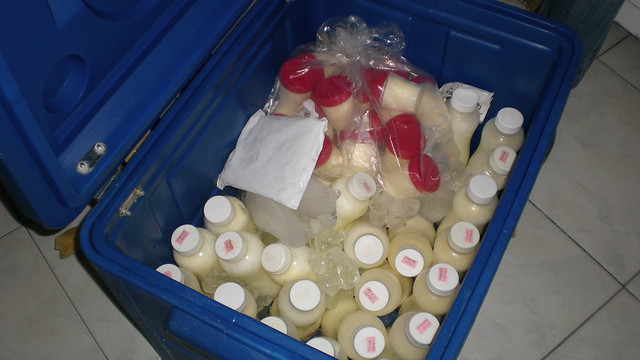
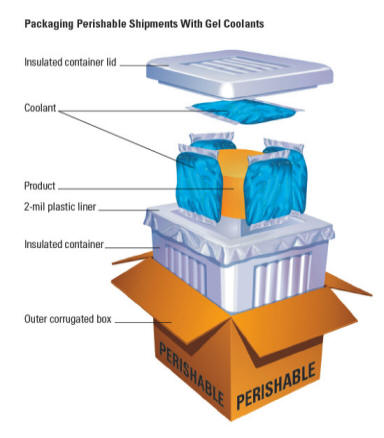
During my trip, after determining I had to check a cooler, I searched online for the best way to accomplish packing, but I found very few resources.  I purchased a cooler on Amazon, meant specifically for shipping food.  I purchased techni-ice and blue gel icepacks.  I filled the cooler completely full with as little space as possible.  I taped (using duct tape) around the top and sides of the cooler to ensure the lid would stay shut.  I put the cooler in a box of the same size (mine came with the cooler).  I labeled the box BREASTMILK and added my address and phone number  in case something went wrong and then I put the whole package in another box.

While I was gone, we did actually end up using donated milk for about 3-4 days.  A close friend of mine who pumps for the Milk Bank brought some over for my husband when he was close to running out of my own stash.  She even offered to wet nurse him.  I have used every single means possible to feed my baby breastmilk.  Nursed, Pumped, and Donated Milk!  I wish I had these friends and community resources earlier with my first baby!


I want to share
my story in hopes that other working moms gain hope that even a business trip doesn't need to end a nursing relationship.  We truly can meet the needs of our children while accomplishing our own dreams.

Wednesday, April 3, 2013

Traveling with Breast Milk, Infant Formula and Baby Food

Photo from   Modern Milk Sharing
You are finishing up your last minute preparations for a quick business trip when all of a sudden you remember all the breast milk you will be pumping while you're away from baby for three days. The thought of dumping all that milk makes you absolutely ill, but what in the world are you going to do with it all?

I've got great news for you! You can take it home with you - even if you're flying! The Transportation  Security Administration has actually created a page specifically to address the needs of traveling parents. Basically, parents are allowed to carry whatever breastmilk, baby food or infant formula that their infant will need. Furthermore, mothers traveling without their babies are also allowed to carry breast milk.

Of course, every mother knows that keeping breast milk cold is vitally important. The TSA has addressed that as well. I called today and spoke with a very knowledgeable and helpful agent who actually sent me additional information.

Breast Milk


  • Breast milk must be separated from other property and declared to a Transportation Security Officer (TSO) prior to entering the checkpoint. Parents are allowed to bring as much breast milk as they will need for the trip. Mothers who have pumped and frozen their milk while traveling may bring that frozen milk with them.
    Photo from Daphne ph
  • If you don't want your breast milk to go through the X-ray screening, you must request an alternative screening before placing it on the belt.
  • When traveling with an infant or toddler, passengers are also allowed to bring into the screening checkpoint more than 3.4 ounces of pre-mixed baby formula (in a liquid, or frozen state); milk products; juice; gel or liquid-filled teethers; bottled water; and canned, jarred, processed baby food and essential non-prescription liquid medications. You must declare these items to a TSO prior to entering the checkpoint.
  • While passengers may be requested to open a container, they will never be asked to test or taste any of these items. If a container cannot be opened, the containers may be allowed into the sterile area only after it and the passenger undergoes additional screening, which may include a patdown. 
  • All frozen items are permitted as long as they are solid and in a “frozen state” when presented for screening. Cooling liquids or gels used to keep medical or infant child exemptions cold are not bound by 3-1-1 requirements and may be presented at the screening checkpoint in a frozen or partially-frozen state. It is important to remember, however, that any item must be properly screened before being allowed into the secure area of the airport.

Breast Pump

  • Individuals traveling with or without a child may bring a breast pump through the screening checkpoint. However, all child-related devices are subject to screening by the Transportation Security Administration (TSA). 
  • You will be asked to place the breast pump in a plastic bin provided at the screening checkpoint and onto the x-ray conveyor belt before walking through the walk-through metal detector. If it does not fit through the x-ray machine, Transportation Security Officers will visually and physically screen the item. 
  • You may place it in a clear plastic bag prior to x-ray screening if you are concerned about contamination, but you must provide your own plastic bag.  

Cooling Elements

Current Transportation Security Administration (TSA) regulations permit regular ice, frozen gel packs, and dry ice in checked baggage and carry-on bags.

Checked Baggage: Regular ice and frozen gel packs in checked baggage are not restricted by TSA. When regular ice is transported, TSA recommends a cooler. For dry ice:
Courtesy of  Eats on Feets

  • TSA requires that its packaging permit the release of carbon dioxide gas.
  • The Federal Aviation Administration (FAA) limits each piece of checked baggage to five pounds of dry ice.
  • The FAA requires that each package of dry ice be marked “DRY ICE” or “CARBON DIOXIDE SOLID."
  • The FAA requires that each package of dry ice be marked with the net weight of the dry ice or an indication that the amount of dry ice is five pounds or less. 
Carry-On Bags: TSA allows frozen items (regular ice, gel packs, and food) at the screening checkpoint as long as they are solid and in a “frozen state” when presented for screening. If frozen items are partially melted or have any liquid at the bottom of the container, the ice liquid container must meet 3-1-1 requirements. For dry ice:

  • TSA requires that its packaging permit the release of carbon dioxide gas.
  • The FAA limits each piece of carry-on baggage to 4.4 pounds of dry ice.
  • The FAA requires that each package of dry ice be marked “DRY ICE” or “CARBON DIOXIDE SOLID."
  • The FAA requires that each package of dry ice be marked with the net weight of the dry ice or an indication that the amount of dry ice is 4.4 pounds or less.