Showing posts with label infant sleep. Show all posts

Thursday, June 15, 2017

Does Your Baby Sleep....Like a Baby?


by Glenni Lorick, IBCLC
Does your baby sleep like a baby? You know, waking every 2 or 3 hours, maybe crying, nursing or taking a bottle, then falling back asleep? Physiologically newborns are not programmed to sleep a stretch longer than about 4 hours. By about 6 months, they might be capable of sleeping a stretch of at least 6 hours (many infants do sleep longer) at night. The fact is that some babies are simply born with easier temperaments than others, making nighttime much easier for some parents than for others.

Why Babies Wake Up

A newborn has a tiny tummy. In fact at birth his tummy will hold about 5- 7 ml of breastmilk comfortably. Many formula feeding parents mistakenly think that their babies need to take most of the 60 ml formula bottle the hospital gives them. Even 20 ml can cause baby's stomach to be too full, leading to discomfort and spitting up. Newborns nurse very frequently - every 2-3 hours or perhaps even more often. Breastmilk is designed to digest quickly, so often newborns wake up hungry after just an hour or two.

Many infants will cluster feed in the evening because that is how they prepare for a slightly longer sleep stretch at bedtime. Breastmilk composition changes throughout the day. In the evening, there is less milk, but it is actually higher in long-chain fatty acids like tryptophan (that wonderful amino acid found in turkey that makes you want to fall asleep after Thanksgiving dinner). It is also higher in sleep-inducing melatonin. A lot of mothers worry that they don't have enough milk in the evening because baby is nursing non-stop. So they end up supplementing in the evening. But that really isn't necessary. The frequent nursing helps baby get what he needs and helps mama produce more milk.

As they approach about 2 months of age, some babies do start sleeping longer stretches of 4-8 hours at night. That is normal. But it is also normal for babies to continue waking several times at night to nurse. At this age babies are still sleeping pretty deeply when they are actually asleep.

Around 4 months many babies experience a sleep regression. A baby who was sleeping a 6-8 hour stretch may suddenly be waking every 3 hours again. The good news is that baby's brain is maturing. The bad news is that these changes are permanent. You will need to help your baby adjust to falling back asleep when he awakens. One way to do that is to help him learn to fall asleep in his crib without you. Most experts do not recommend letting baby "cry-it-out" because research has shown that can actually be harmful. However, there are gentle methods to help baby learn to sleep. The No Cry Sleep Solution by Elizabeth Pantley is a terrific resource that many parents have found to be invaluable.

Where Baby Sleeps

The American Academy of Pediatrics came out with revised sleep recommendations in 2016. They recommend that babies sleep in a "separate but proximate"sleep environment. That means that baby should sleep in Mom and Dad's room, but not in their bed. Nevertheless, in this revision, the AAP did acknowledge that mothers do sometimes fall asleep while nursing. 
"However, the AAP acknowledges that parents frequently fall asleep while feeding the infant. Evidence suggests that it is less hazardous to fall asleep with the infant in the adult bed than on a sofa or armchair, should the parent fall asleep. It is important to note that a large percentage of infants who die of SIDS are found with their head covered by bedding. Therefore, no pillows, sheets, blankets, or any other items that could obstruct infant breathing or cause overheating should be in the bed. Parents should also follow safe sleep recommendations outlined elsewhere in this statement. Because there is evidence that the risk of bed-sharing is higher with longer duration, if the parent falls asleep while feeding the infant in bed, the infant should be placed back on a separate sleep surface as soon as the parent awakens."

 Dr. James McKenna is a professor of Biological Anthropology and the director of the Notre Dame Mother-Baby Sleep Laboratory. He has written extensively on the biological reasons for mothers and babies to share sleep environments. He also has created safe co-sleeping guidelines that any family who is practicing co-sleeping should be very careful to follow. Everyone agrees that the most dangerous place for an infant to sleep is a recliner or sofa, even with a caring adult. If that adult falls asleep the risk of the infant suffocating is many times greater than it would be on a firm sleep surface such as a futon or firm mattress.

Getting Help 

Fortunately  we have a local infant sleep expert. Dana Stone is the mother of four children. When she had serious sleep issues with her last baby, she looked for answers. She knew that the traditional cry-it-out method wasn't right for her family, so she found a program that helped her gently teach her child to sleep. She ended up becoming a certified Sleep Sense consultant and has helped dozens of local families get a good nights' sleep.  She offers a free download for parents entitled "Five Steps to Getting Your Baby to Sleep Through the Night." It is important to recognize that nobody expects an infant to sleep through the night. Physiologically they just aren't ready to do that. However, later in the second half of the first year, many babies are capable of sleeping an 8 hour stretch. Dana is able to work with your individual situation and help your baby sleep a little less like a baby!

Friday, May 31, 2013

Late Night Advice for Tired New Mommies

My kids are all in their teens and twenties...and I still have some late nights with them. But I remember well the days when I was up in the middle of the night....the days when the baby sleeping next to me wanted to nurse all night long....the days when morning came way too fast and I was just exhausted. So the other night I asked our ANM moms what advice they would give to a tired new mommie at 11:00 at night. We got some terrific responses that should help any new mama struggling with sleep deprivation!

Sleep When You Can

Snatching sleep anywhere you can was a common theme.  K. suggested, "If they are nursing, try to nurse while laying down. I would cat nap while my daughter nursed once I found out she would nurse while we both lay on our sides. Those micronaps saved me!"

R. said, "Take a deep breath - this too shall pass.  Oh, and forget the housework - SLEEP!"  

B. added, "Sleep every time baby sleeps - the laundry can wait!"

M. offered this advice: " Do whatever it takes to get some sleep. Whether that's putting baby in bed with you, in a separate sleep space, or asking dad to tend to baby until baby's ready to eat again. Whatever works. Take a nap tomorrow, too, at least one. Don't worry about the dishes or the laundry or sweeping the floor; it will all still be there when you aren't feeling so tired.

A. said, "Nap when your baby naps, eat when your baby eats (if you can), breathe, get something to drink and think of something relaxing or watch TV." 

S. offered this very practical suggestion:  "Cosleep and read The No Cry Sleep Solution. It helped me to understand sleep better in general...and to be more realistic. Pantley explains it so well!"

L. proferred these words of encouragement:" At some point, they do start sleeping through the night!"  

Use Your Support Network

Several moms pointed out the importance of taking advantage of any help you can get.  E. said, "It's okay to ask for help from a family member or friend!" 

T. added, "This is not forever. you can handle this. Maybe through tears and most likely with some much-appreciated help, but you can handle this. Make sure you've had some food and lots of water, and crawl in bed the moment you can."   

A. had this to say, "If you can, take a mini-break for yourself once a dy. It could be as simple as going to buy a coke BY YOURSELF with no noise and no one to take care of. It could just be taking a bath or shower. Little breaks help you stay sane. And everyone has days where they put baby in Dad's arms and say 'I can't do it any more right now.' Take a break and you can do it again. My first was colicky...sometimes you have to put them down in their bed and walk away for a minute. The best thing to do is surround yourself with positive, encouraging people. It's a hard job, but it's the best job and only you can do it as well as you can, because YOU are MOM!" 

Create a No-Guilt. No-Stress Zone

One of our mantras at A Nurturing Moment is "We don't do guilt!"  S. had this to say: "It's okay if you are frustrated or angry...don't feel guilty -- it doesn't make you a bad mommy or mean you love your baby any less. You will feel better after you get a little bit of rest!"  

Image from womenshealth.gov.
H. offered this advice: "If you or baby can't sleep (particularly if baby is nursing at short intervals all night long), make yourself a little "nest" someplace like the recliner; get comfy, play your favorite movies/tv shows (or load your Kindle with a great book), and hang in there.  Sleep will happen before too long. In the meantime, try not to stress, and know that this too shall pass. Any you'l probably look back and freak out that it's passed so quickly!" 

G. added, "It's really hard to enjoy something when you can barely function. It is worth enjoying; it IS exhausting, and whatever you are feeling is real. If baby is screaming, put her down in a safe place, go pee, get a drink of water, maybe a bite of chocolate, and relax. The go back and be a mommy again." 

E. offered this encouragement: "Trust yourself. You're doing great!"

Treasure These Moments 

Many of our moms talked about how quickly time passes and suggested looking for the good in this situation.  

C. said, "Enjoy the snuggle time and soak it all up because they grow up way too fast." 

G. added,"Time flies by...blink and they grow. You won't be nursing them at 11:00 pm for very long." 

P. suggested a wonderful post from her blog, Adaptive Mom and said, "Enjoy every moment. You will miss these moments someday."  

Darius Rucker with his 4 year old son, Jack
R. had this to say: "Enjoy it!!! It will be over soon and will never happen again; she will be on to a new chapter in her life and will laugh about it one day!"  

B. said, "It won't be like this for long!"  and K. added, "It gets way more fun!"

M. concluded with these words of wisdom: "I would tell her to take advantage of the quiet and alone time with just you and baby when those late night sessions come around. I loved when it was just me and baby up while everyone else was sleeping...it was our alone time to just snuggle. No getting water for the other kids, no expectations from anyone else. Just us. Make the most of it."  

Thursday, May 2, 2013

Grandma Rules

Nicholas turned one today!
by Glenni Lorick, IBCLC
One year ago today my oldest daughter gave me the most amazing gift ever, my first grandchild! I've thought a lot about this marvelous first year of Nicholas' life. I have thoroughly enjoyed watching my daughter be a mother. I love hearing the little voice she saves just for Nicholas. Her face lights up just talking about him. This year has given me a wonderful new appreciation and respect for her.

Here at A Nurturing Moment I work with a lot of young moms - some younger than my daughter and some older. I see many amazing grandmothers come in with their daughters and grandbabies. Most of the time, the grandmother is incredibly supportive of the daughter.

Sometimes, however, I will see a mom who is truly upset because her mother (or perhaps it's her mother-in-law) doesn't think she's doing a good-enough job. I decided to address this issue with a few "Grandma Rules" because it is heartbreaking for the new mother. She really longs for her own mother's approval. Sometimes it's so bad that the new mother feels she has to put some distance between herself and her mother (or mother-in-law.) That just leads to more hurt feelings, misunderstandings and perhaps ugly words.

Grandma's Role

Whether you like it or not, if you're the grandmother, then your job is to support and encourage the mother. Maybe she isn't doing things the way you would do them. SO WHAT??? This is her baby! You had your turn at being a mother, now it's her turn. She is the expert on her baby, not you! Your job is to support and encourage her. If you disagree with something she's doing, it's fine to gently make a suggestion, but then leave her alone. You raised her to be the woman she is, so have some confidence in her abilities!

After 24 hours of labor, Sarah got her epidural and felt great!
I love my daughter very much, but she certainly is not my clone! We have very different views in several areas:
  • Childbirth: I am a huge advocate of natural, unmedicated birth. I had a bad epidural experience and three amazing natural births.  Sarah, on the other hand, was all about getting that epidural. She woke up in labor at 3:00 am on May 1 and had progressively stronger contractions throughout the day. We headed to the hospital around midnight. After a horrible night of labor (with her mother who was there to support her snoring loudly on the pull-out bed next to her), she really needed the relaxation the epidural afforded her. It was her choice, and she had the birth she wanted. I was thrilled for her!
  • Breastfeeding: I'm a IBCLC and nursed all my kids at least two years. Sarah wanted very much to breastfeed, but because Nicholas  was 7 weeks premature, they didn't get off to a good start. But boy could she pump! She pumped religiously for him for 4 months. At that point she was just ready to be done. I told her how proud I was of her for giving Nicholas 4 months worth of liquid gold. 
  • Nicholas was just 3lb. 6oz. when he was born
    and spent 5 weeks in the NICU.
  • Nighttime Parenting: From the time Sarah was 6 months old (and we discovered Dr. Sears) we co-slept. All of our babies were in our bed and we loved it. Nicholas slept in his parents' room for the first few months after he came home, but then they moved him upstairs to his crib where he slept through the night quite well. There were certainly nights when he was in their room, but he seems to really like being in his crib. My daughter is the expert on her baby and knows what he needs.
Nourish Your Relationships

Grandmothers have several very important relationships to nurture.

Spouse:  The first and most important is with grandpa, if he's in the picture. Those who are blessed enough to have made it 25+ years in their marriage need to continue cherishing and building that relationship.

Child: The next critical relationship is the one with your own child. If your daughter is the new mother, she is probably really longing for your support and affirmation. She needs to know that you think she's doing a good job. Remember when mothering was brand new for you? Remember how uncertain you were? Even when she's grown the most important thing you can give your daughter is unconditional love and affirmation.

I love being with my daughter and grandson!
Maybe you didn't breastfeed, but you can still support her in her decision to nurse her baby. If you feel like she's making lifestyle choices that are truly dangerous (drug use, ignoring her baby, etc.) then you absolutely need to confront her and intervene if necessary. But feeding method and parenting style are NOT in the category of dangerous lifestyle choices.

If your son is the new dad, you need to recognize that your daughter-in-law probably has a special bond with her own mother. Allow her to invite you in; don't push your way in. Be there to support and encourage, but don't try to manage their lives. If you do, you may find that you cause serious damage to your relationship with your son.

Grandchild: This is the fun, wonderful relationship where you get to indulge, love and maybe even
spoil your precious grandchild just a little bit. However, be mindful of the boundaries his parents have set. If his mom doesn't want to start solids until he's at least 6 months, then don't try to sneak in a little rice cereal just because you think he's ready for it. If she doesn't want him to have sugar, then don't give him a cookie when he's at your house. If you make an effort to do things her way and respect her parenting method, it will make things much easier on your grandchild. He won't be confused as he gets older.

Grandbaby snuggles rock!
Don't ever say anything negative about either of his parents - even if they're not together any more. Growing up as a child of divorce is hard enough without having a grandparent spouting venom about one of your parents! Your job as a grandparent is to love your grandchild, give him a safe home away from home, and support his parents in all you say and do!

If you follow these simple "Grandma Rules," you'll find yourself surrounded by children who really appreciate you and grandchildren who absolutely adore you! After all, Grandma Rules!!

Wednesday, January 2, 2013

Really?


by Erin Atkins, guest blogger

Image from Shutterstock.com
My daughter is eleven months old and doesn't sleep at night.  Well, she doesn't sleep in one long stretch anyway.  We still probably get about ten hours of sleep, but it’s usually not for more than about two hours in a row.  And I say “we” because baby E sleeps with me since it’s the only way I can manage shut-eye with her frequent stirrings.  I've mastered the art of side-lying nursing, so when she awakens throughout the night, I immediately offer my secret weapon.  I like to refer to this process as my snooze button.

Up until about a month or two ago, I was embarrassed, annoyed, and frustrated by the whole situation.  My husband and I have spent months trying to figure out ways to get her to stay asleep.  We tried various techniques and sleeping arrangements.  We tried decreasing her stimulation throughout the day.  We tried wearing her.  We tried wearing her out.  We encouraged more naps, fewer naps, earlier naps, later naps.  I read several books on nighttime parenting and tried to play with every different variable to coax her to a long night of slumber.  We've done the noise machines, music, silence, darkness, night lights, pacifiers, blankets, “lovies,”… the list is seemingly endless.  I finally came to the conclusion: this is just how she is.
Getting eight hours of consecutive sleep is not the line at which I draw my parenting limit.
With this final revelation has come confidence and empowerment.  I have spent many sleepless nights pleading with God that I get a good night’s sleep, but over time, I am starting to understand that God has chosen me out of all the moms in the world to be this non-sleeper’s parent, and it’s a role I should take seriously and gracefully.
Photo from Motherhoodthetruth.com

As a result of this new-found revelation, I have altered my approach with other moms who inquire into the sleeping habits of my child.  I was recently asked by a well-meaning mom, “So, is she sleeping through the night?”  Now, for those of us with kids who don’t sleep ten hours in a stretch, it conjures up feelings of inadequacy and shame, as if I have failed as a parent.  And normally when someone asks me this question, I find myself making all sorts of excuses: “Well… she’s a high-needs baby;” “Well… I didn't sleep through the night until I was a five, so she was destined to be a non-sleeper;” “Well… she’s teething.”  I then usually get into how it’s not so bad because she sleeps next to me, and I can nurse her to sleep blah blah blah.  Regardless of my explanation, it’s almost invariably met with the same response, “Oh wow.  I could never do that.”

Most of the time, I would let the conversation end there or move on to a different topic, but this last time, I had a sudden revelation about parenting.  This time, when this particular mother informed me she could never get up more than once a night with her little one, I simply asked, “Really?” 
Photo from Neuroanthropolgy.net

Don’t get me wrong, I would LOVE eight hours of uninterrupted sleep.  Heck, I would LOVE three hours of uninterrupted sleep.  I don’t exactly look forward to being woken up multiple times a night by my active baby girl, and there’s certainly a big part of me that wishes, hopes, dreams of one day getting a full night’s sleep.  But is waking up throughout the night something I’m unwilling to do for my daughter?  Absolutely not.

It was at this moment that I thought, there is nothing I wouldn't do to meet my daughter’s needs, and instead of being embarrassed or worried about admitting my child doesn't sleep through the night, I should be honored that God knew I could handle it.  Getting eight hours of consecutive sleep is not the line at which I draw my parenting limit.  I am baby E’s mom 24 hours a day, so if she needs me at night, so be it.  It’s my job, and I love her.

Erin Atkins is a stay at home attorney who is enjoying time with her first baby. She is blessed to be able to work from home, and loves watching baby E develop, going on play dates, and traveling with her family.

Saturday, December 22, 2012

Silent Night -- Yes, It IS Possible!

If you have a new baby in your house this Christmas, you might be fervently praying for just one silent night! The early days of parenting can be absolutely exhausting, especially if you're not getting the sleep you need at night.
Picture from vsonlinediary.blogspot.com

It seems that newborn babies often come programmed to sleep all day and nurse all night. You need to reprogram your baby ASAP! That's not such a hard task really; you just have to teach baby that daytime is for being awake and eating, and nighttime is for sleeping.

Reprogramming Baby 101

Follow these simple steps to help your baby overcome day-night confusion.
  1. During the day be sure to nurse your newborn at least every 2 -3 hours, counting from the beginning of one feed to the beginning of the next one.
  2. About 2 hours after the last feed began, begin watching baby for signs of REM sleep. When you see him sucking in his sleep and moving a little bit, pick him up to awaken him. If you don't catch him, he may go back into a deep sleep, and you won't be able to awaken him at all.
  3. Unswaddle baby and take off her clothes. Change his diaper to really get him awake.
  4. Make sure that when baby is at the breast she is actively nursing. Use breast compression to keep her suckling when she stops for more than about 15 seconds.
  5. In the evening if baby wants to nurse several times close together (cluster feeding), let him. He will get more hindmilk which is rich in long-chain fatty acids when he cluster feeds. One of those fatty acids is tryptophan which will help baby sleep longer and better at night.
  6. As soon as you put baby down for her long sleep stretch, you go to bed, too! In the early days you need as much sleep as you can get!

Back to Normal

Okay, I guess it's time to tell you the truth...Things will NEVER be like they were before. You now have a new normal. But there will come a time when you are able to get a good night's sleep once again. Your child will learn to sleep. Whether you co-sleep or have baby in a separate but proximate sleep environment as the AAP recommends, the ideal place for your newborn is in your bedroom. You will both get more sleep if baby is nearby. You will find that if baby doesn't wake up completely in the middle of the night frustrated because nobody is there, he will settle down and nurse much more readily and go back to sleep more easily.

So relax, reprogram, and enjoy a silent night this Christmas!

Saturday, April 28, 2012

Sweet Baby Snuggles

From Neuroanthropology.net
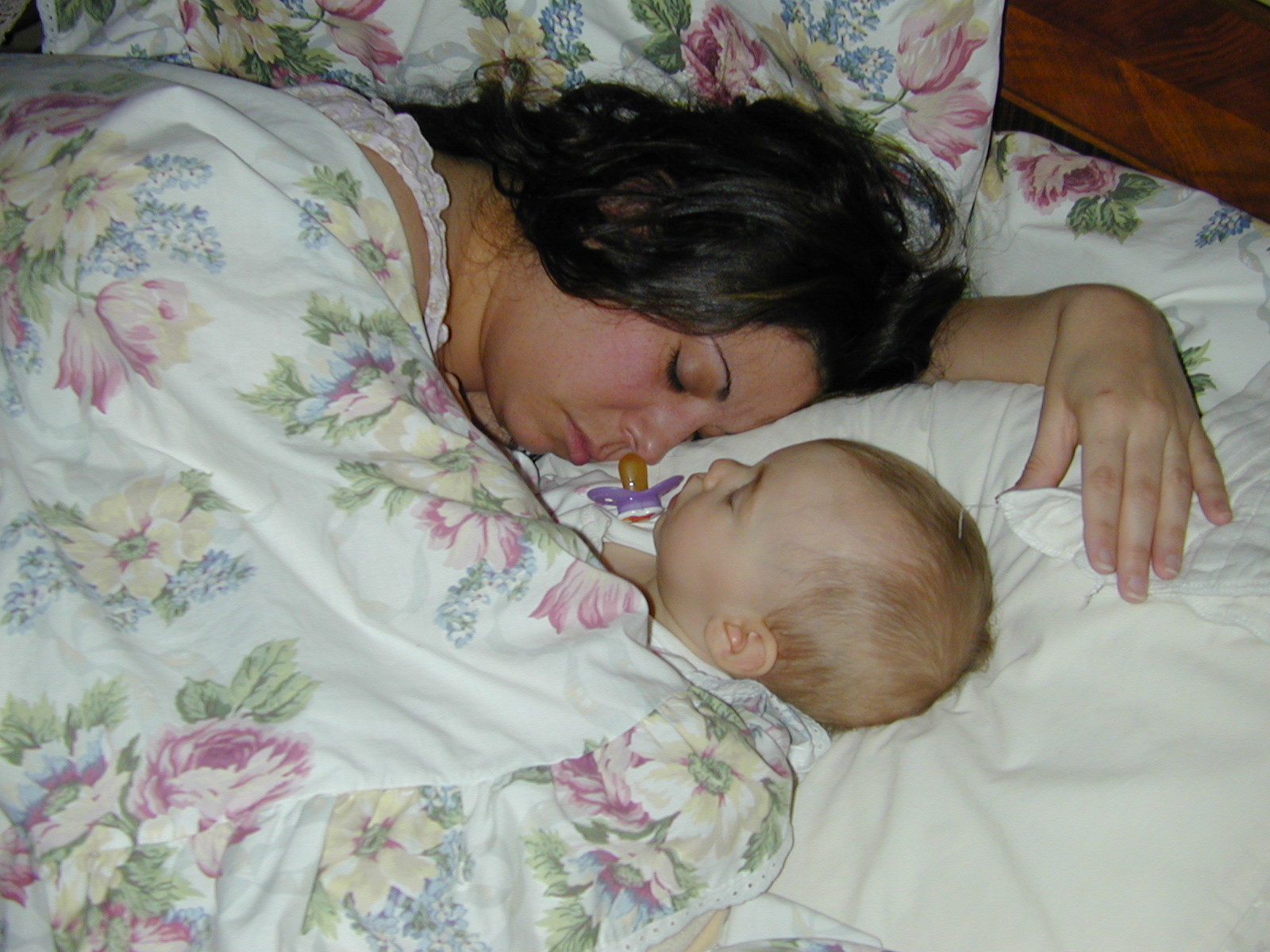
 I recently asked mothers what was their favorite time of day and why. I wasn't surprised at all to see the responses of moms who said the time they most love is when baby is snuggled in bed with them. What's not to love about a milk-drunk baby nestled securely in your arms in the comfort of your bed? Combine that with the relaxing effect of breastfeeding hormones, and you've got a delightfully peaceful scene.
Throughout the history of the world, mothers have known that the safest place for a baby to sleep is snuggled next to them. However, with the invention of pillow top mattresses and lots of fluffy bedding, suddenly it isn't so safe any more. In fact the American Academy of Pediatrics says the safest place for an infant to sleep is in a separate but proximate sleep environment. So are moms who snuggle with baby in bed actually putting baby at risk?

The answer is complicated. Noted pediatrician Dr. William Sears has some very interesting observations about the matter. Dr. James McKenna heads the Notre Dame Mother Baby Behavioral Sleep Laboratory. As a biological anthropologist, he has devoted years of research to the effects of co-sleeping on mother and baby. It's no coincidence that so many mothers say their favorite time of day with baby is when they're snuggling in bed. There are numerous health advantages to the infant from sleeping close to its mother. However, parents benefit as well.

So am I recommending that all parents bring baby to bed with them? Absolutely not!! Dr. McKenna has some important safe co-sleeping guidelines that parents need to read if they're contemplating having baby in the same bed. Many mothers really don't feel comfortable having baby sleep all night in the same bed; those mothers can benefit tremendously from the Arm's Reach Co-sleeper which allows baby to sleep right next to mother without being in the same bed.

Regardless of how you choose to sleep, remember that those sweet baby snuggles are priceless, and pretty soon your baby will be a toddler who is way too busy for long snuggles!

Wednesday, November 2, 2011

Nap Nanny Makes Sleep a Reality

Just over a year ago, much to the dismay of many parents, the Nap Nanny was recalled because a child had actually died in one. Then why in the world is this a product that we would promote? That's a terrific question - I'm so glad you asked it!!


The new Nap Nanny Chill has undergone a design revision to make it safer. After voluntarily recalling all the current Nap Nannies, the creators waged a full-fledged media campaign to make sure that parents were using their product correctly. It turns out that the child who died was in a Nap Nanny that had been placed in a crib -A HUGE NO-NO!! In fact, Nap Nanny posted this video to instruct parents on the proper use of their product.


So what is it about the Nap Nanny that makes us want to carry it? First of all, it's important to emphasize that the company makes no medical claims whatsoever about their product. They don't claim that it helps with reflux. The certainly don't claim that it reduces SIDS. So what does it do? It provides a very safe separate-but-proximate sleep environment for infants who weigh at least 8 lbs. When used correctly, the Nap Nanny will be placed on the floor. It angles baby's body in such a way that  baby can fall asleep and stay asleep more comfortably. That's great news for parents who are sleep deprived and worried sick over their infant. When used according to directions, the Nap Nanny offers a completely safe place for baby to sleep. 


What makes it different from wedges? A wedge is actually placed in the crib under the mattress. Often babies tend to slide down. If baby slides down or isn't placed correctly, airway constriction can occur. The Nap Nanny has a harness that securely fastens baby in place. The manufacturer says that once a baby is mobile and starting to sit up, he should not be left in the Nap Nanny to sleep. However, as baby gets older, the Nap Nanny morphs into the ideal toddler recliner. It's the perfect little seat for him to sit in while he looks at a book or plays quietly in his room.


The big question is, "With a price tag of $130, is it really worth it?" One of our ANM moms said this: "A life saver!!!! He had colic real bad and once we got one he started sleeping through the night!"  Another said, 
"We have one and love it!" and a third mom commented, "We love ours!"


If you're ready to get some sleep, come on by and check out the Nap Nanny. Mention this blog post, and save 10% off the regular price!